
The entire process being autonomous when the lander has to fire its engines at the right times and altitudes, use the right amount of fuel, and scan of the lunar surface for any obstacles or hills or craters before finally touching down.

The ISRO is aiming for a soft landing of the lander in the South Pole region of the moon where no country has gone so far.

The year ended with the launch of the PSLV's 50th mission.

The mission life of the 2,250kg GSAT-7A, built by ISRO, is eight years. It will provide communication capability to users in Ku-band over the Indian region.

The 6-metre tall launch vehicle Vikram-S is named after Vikram Sarabhai, the father of the country's space programme and lifted off at 11.30 am.

The SSLV is designed to be affordable and amenable to industry production and aimed to function as a launch-on-demand platform for mini, micro or nano satellites.

"I am extremely happy to announce that GSLV Mark III successfully injected Chandrayaan 2 in the defined orbit, infact the orbit is 6,000 km more than what was intended," Sivan said.

'If you align your ambition with India's rise, the peak of your careers will unfold alongside the peak of India's power.'

Heralding a new era, India on Friday night launched its heaviest commercial space mission ever with its polar rocket successfully putting five British satellites into the intended orbit after a flawless takeoff.

The satellite would provide a thrust to mobile communication through multi-beam coverage facility, the ISRO said.

The Indian Space Research Organisation on Sunday faced a blip in its plan to tap the small satellite launch vehicle market, as an anomaly in the placing of the satellites by the rocket led to deviation on its path thereby becoming 'no longer usable', Chairman S Somanath said on Sunday.

It also carries equipment for meteorological data relay and satellite based search and rescue services being provided by earlier INSAT satellites.

A visibly emotional Modi addressed scientists at the Indian Space Research organisation's command centre in Bengaluru, who were involved in the Chandrayaan-3 mission and lauded them for their efforts.

The successful orbiting of the satellites by the Polar Satellite Launch Vehicle PSLV C-40 comes four months after the Indian space Research Organisation's mission to launch backup navigation spacecraft IRNSS-1H onboard PSLV-39 ended in a rare failure.

Artificial Intelligence, innovation and next-generation technologies figured prominently during the high-stakes discussion between Prime Minister Narendra Modi and US President Donald Trump at the White House, as the two sides announced transformative measures, including the US-India TRUST initiative, roadmap on accelerating AI infrastructure and INDUS Innovation, to boost tech ties.

In a textbook mission, ISRO's PSLV-C32 lifted off from Sriharikota and later injected the IRNSS-IF in sub-Geosynchronous Transfer Orbit.

With the Indian Space Research Organisation set to launch the Mars Mission on November 5, Chairman K Radhakrishnan, in an interview with Praveen Bose, talks about the complexities, the challenges and the benefits of the Rs 450-crore mission.

The 3,357-kg satellite, which was deployed from the lower passenger position of Ariane-5 launch vehicle (VA 251) into the geostationary transfer orbit, is configured on ISRO's enhanced I-3K Bus structure to provide communication services from Geostationary orbit in C and Ku bands.

The Indian Space Research Organisation has resolved to alight its lander on the lunar surface with Chandrayaan-3 in addition to a maiden solar expedition in 2020.

The heaviest rocket of the Indian Space Research Organisation -- LVM3-M2/OneWeb India-1 -- blasted off from the Sriharikota spaceport on Sunday to place 36 broadband communication satellites into the Low Earth Orbit (LEO) for a UK-based customer.

The ISRO lost communication with the satellite when it attempted to ignite the engine in a third and final move to its desired location.

Other than the Cartosat-2 series satellite, the PSLV is carrying 29 nano satellites from 14 countries - Austria, Belgium, Chile, Czech Republic, Finland, France, Germany, Italy, Japan, Latvia, Lithuania, Slovakia, the United Kingdom and the United States of America besides a nano satellite from India.
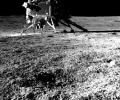
Chandrayaan-3 mission's Pragyan rover on Wednesday clicked an image of the Vikram lander, ISRO said.
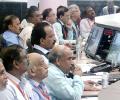
Leading scientists and experts said this monumental accomplishment not only marks India's indelible imprint on lunar exploration but also demonstrates the prowess of human collaboration, determination, and cutting-edge technology.

Chandrayaan 3 follows the Chandrayaan 2 mission which did not achieve the desired soft landing on the surface of the moon in 2019, disappointing the scientists.

The space agency said Chandrayaan-2 planned for mid-April.

Eminent rocket scientist S Somanath has been appointed as the chairman of the Indian Space Research Organisation as well as the space secretary, a personnel ministry order issued on Wednesday said.

He said the ISRO scientists have a very strong spirit of working and will not rest till the objective is met.
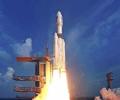
Taking its baby steps towards realising India's ambition to send humans into space, Indian Space Research Organisation on Thursday successfully tested the atmospheric re-entry of a crew module after its heaviest launch vehicle GSLV MK III blasted off from Sriharkota.

About 80 per cent of Indians have a favourable view of Prime Minister Narendra Modi and around seven in 10 Indians believe their country has recently become more influential, according to a survey by the PEW Research Center.

The Mars mission is overwhelmingly irrelevant to space science and won't advance the frontiers of knowledge. It will divert attention from the real technological challenges facing the Indian space programme, and will further distort our science and technology priorities, says Praful Bidwai.

In a giant leap for its space programme, India's Moon mission Chandrayaan-3 touched down on the lunar south pole at 6.04 pm on Wednesday, propelling the country to an exclusive club of four and making it the first country to land on the uncharted surface.

Thursday's launch is the last one of 2020 for ISRO.
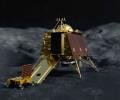
A number of private companies have contributed to the development of ISRO's Chandrayaan-3 spacecraft which successfully landed near the south pole of the Moon on Wednesday evening.

The feat is the second one for the Indian Space Research Organisation scientists in using the indigenously made cryogenic stage after the January 5, 2014 launch of GSLV-D5.

The space strategist said that this shows that one should not take anything for granted in space exploration.

The Lagrange point 1 (L1) of the Sun-Earth system is about 1.5 million km from the Earth. It is about one per cent of the total distance between the Earth and the Sun.
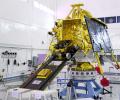
The cubical vehicle, exclusively designed for travelling on the moon, is fitted with a solar panel.

An entire nation waited, praying and hoping fervently, as the countdown to touch down on the moon wound to a slow close on Wednesday with many thousands gathering in schools, places of worship and elsewhere and scientists doing last minute checks to ensure Chandrayaan-3 makes a soft landing on the lunar south pole.
.jpg)
India's maiden mission to Mars has traversed beyond the sphere of influence of Earth extending about 9,25,000 km in its 10-month long voyage to the red planet.
